
"coffee seed layers"
2000 article(s) found

Honey treatment Analysis of Golden Honey treatment Honey treatment and washing Coffee Raw Soybean Honey treatment
Professional coffee knowledge exchange more coffee bean information please pay attention to the coffee workshop (Wechat official account cafe_style) Golden Yellow Honey treatment (Gold Honey) the emergence of the secret honey treatment, the earliest is to improve the centuries-old fermented washing method. Basically, it removes the pectin layer adhered to the surface of coffee seeds by mechanical scraping. And scraping off the pectin layer

The harvest of coffee beans
After 3 or 4 years of growth, the coffee tree matures and begins to bear fruit, and one fruit will be arranged in clusters or clusters along the branches. Of course, the coffee beans we see are the seeds of coffee trees. The outside of the seed is a layer of peel, which can be picked as soon as it turns red. Under the red skin (exocarp) there is a layer of pulp (mesocarp), inside is a small thin layer, and then there is a layer of parchment

Basic knowledge of Coffee picking of raw coffee beans
After 3 or 4 years of growth, the coffee tree matures and begins to bear fruit, and the fruit will be arranged in clusters or clustered together along the branches. The coffee beans we see are the seeds of the coffee tree. The outside of the seed is a layer of pericarp, with the maturity of coffee beans, the pericarp will change from green to red, as soon as it turns red, it can be harvested. The structure of coffee fruit is that there is a layer of pulp (mesocarp) under the exocarp.

What is the structure of coffee fruit? can you eat it? seven structural effects and functions of peeling coffee fruit layer by layer
Professional coffee knowledge exchange more coffee bean information please follow the coffee workshop (Wechat official account cafe_style) front street-coffee bean structure introduction coffee fruit has many layers from the inside out, the outermost is: coffee peel. Depending on the variety, the color of the coffee pericarp will start from the beginning with the process of maturity.
Common sense of Coffee Tree planting
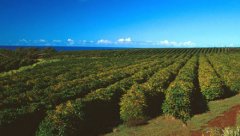
After 3 or 4 years of growth, the coffee tree matures and begins to bear fruit, and one fruit will be arranged in clusters or clusters along the branches. Of course, the coffee beans we see are the seeds of coffee trees. The outside of the seed is a layer of peel, which can be picked as soon as it turns red. Under the red skin (exocarp) there is a layer of pulp (mesocarp), inside is a small thin layer, and then there is a layer of parchment
What are the steps and harvest time for picking coffee beans
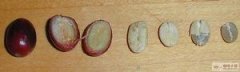
After 3 or 4 years of growth, the coffee tree matures and begins to bear fruit, and the fruit will be arranged in clusters or clustered together along the branches. The coffee beans we see are the seeds of the coffee tree. The outside of the seed is a layer of pericarp, with the maturity of coffee beans, the pericarp will change from green to red, as soon as it turns red, it can be harvested. The structure of coffee fruit is usually a layer of pulp (mesocarp) under the exocarp.

What is round bean coffee (PB)? How should round bean coffee be selected? Are round beans delicious?
Professional coffee knowledge exchange more coffee bean information please follow the coffee workshop (Wechat official account cafe_style) what is round bean coffee (PB)? Coffee is a kind of fruit, and the outer layer of coffee fruit has pulp (pectin layer), and the middle is usually composed of two seeds facing each other (just like the fruit we usually eat). The plane of the two seeds is facing inward, and the round face is opposite.

Introduction of Rwandan raw beans with bourbon seed and water washing treatment
Most of the coffee in Rwanda is washed. The water washing method will first wash and flotation the ripe coffee fruit, then remove the exocarp, pulp and part of the pectin layer, then send the coffee into the fermentation tank, remove the remaining pectin layer and then send it to the drying ground for drying treatment, so that the water content reaches about 13%. The coffee in the picture above is placed in an African shed to dry.
Fine Coffee Science explains the picking of coffee beans in detail
After 3 or 4 years of growth, the coffee tree matures and begins to bear fruit, and one fruit will be arranged in clusters or clusters along the branches. Of course, the coffee beans we see are the seeds of coffee trees. The outside of the seed is a layer of peel, which can be picked as soon as it turns red. Under the red skin (exocarp) there is a layer of pulp (mesocarp), inside is a small thin layer, and then there is a layer of parchment

What is the honey treatment of coffee beans? What is coffee honey treatment?
The coffee beans we use when making coffee are actually the seeds inside the coffee fruit. In the outer layer of the seed, there are exocarp, pulp, pectin, endocarp and silver peel and other structures, and the purpose of processing is to remove these external structures in order to obtain internal coffee seeds. Review on the rise of Water-saving Taste in Honey treatment; the three major treatment methods of coffee: sun exposure, washing and honey treatment
Cultivation techniques of Baoshan small-grain Coffee
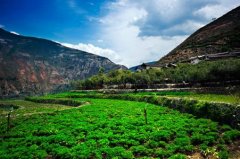
I. the environmental conditions required by small-grain coffee originated in Ethiopia in north-central Africa, located in 69 N, 3440 E, 13001900m above sea level, with 16001900mm precipitation and an average annual temperature of 20 ℃. In the process of long-term evolution, coffee has specific requirements for environmental conditions due to the joint action of biology and climate.
Botanical characteristics of small seed Coffee
Coffee is a shallow root crop, and the plants propagated by seeds are conic roots. From the point of view of varieties, the roots of small and medium grain species are shallow, while those of large grain species are deeper. Yunnan small grain coffee is a 3-year-old 4-year-old fruit tree with a deep main root of about 70cm.

The story of the flavor characteristics of Indonesian wet planing coffee beans
Professional coffee knowledge exchange more coffee bean information please follow the coffee workshop (Wechat official account cafe_style) which beans in Indonesia are wet shaved? What flavor does wet planing highlight? What is wet planing? Wet planing (Wet-Hulling), that is, when the raw beans are in the middle of the sun and the moisture content is as high as 30% 50%, the seed shells are removed before continuing.
What are the fruits and seeds of coffee? What the coffee beans look like.
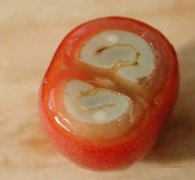
Coffee Cafe Coffee popular Science Coffee (coffee cherries) is oval, coffee flowers lag behind, the fruit is only the size of a match head, after 6 to 8 months of growth will slowly become larger. The size of the coffee fruit varies according to the cultivation environment and variety. If it is Arabica, the fruit will be the size of 1.5~2cm, and the more cross-sectional diameter will be in 1~1.5cm.

What is the structural stratification of coffee fruit? Is it true that there are five floors from the inside out?
The picture above shows the plane structure of coffee fruit. A mature and complete coffee fruit is divided into the above five parts. This picture shows the cross section of the coffee fruit, from which you can see the main structure of the coffee fruit more intuitively. Coffee should be grown with seeds with endocarp, and the raw coffee beans we usually come into contact with have already

What are coffee beans? The taste of round bean coffee do you want to pick out round beans?
Professional coffee knowledge exchange more coffee bean information Please pay attention to the coffee workshop (Wechat official account cafe_style) often hear people talk about "public beans", "mother beans", in fact, coffee beans do not really have parents, a more correct statement should be round beans: coffee is a kind of fruit, and the outer layer of coffee fruit has pulp (pectin layer), the middle is usually composed of two seeds face to face (namely
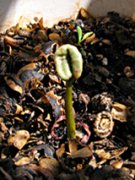
60 days after sowing, coffee seed beans
After 60 days of sowing, the germination period of coffee seed beans after initial radicle germination should be based on the principle of keeping the seedling pot moist. Ideally, in the temperature range of 19-26 ° C and moisture conditions, seeds need 55-60 days from sowing to emergence, with the highest emergence rate at 80 days. Kunming is in the temperature range of 6-25℃ during this period, so the seedling pot is intentionally placed on the sunny windowsill in the house and covered with plastic at night.

Botanical characteristics of small seed Coffee
1. Root coffee is a shallow root crop, and the plant propagated with seeds is a cone root system. From the point of view of varieties, the roots of small and medium grain species are shallow, while those of large grain species are deeper. Yunnan small grain coffee is a 3-year-old 4-year-old fruit tree with a deep main root of about 70cm. The lateral root that grows horizontally from the main root is called the horizontal lateral root, the vertical lateral root grows downward, and the root extracted from the lateral root is called the secondary lateral root.
Coffee knowledge Coffee growth cycle and picking
Coffee beans are the seeds of coffee trees. After three or four years of growth, the coffee tree matures and begins to bear fruit, with one fruit arranged in clusters or clusters along the branches. The outside of the seed is a layer of peel, which can be picked as soon as it turns red. Under the red skin (exocarp) there is a layer of pulp (mesocarp), which is a small thin layer, and then a layer of material endocarp like parchment. In

Botanical characteristics of small seed Coffee characteristics of Coffee in Yunnan
1. Root coffee is a shallow root crop, and the plant propagated with seeds is a cone root system. From the point of view of varieties, the roots of small and medium grain species are shallow, while those of large grain species are deeper. Yunnan small grain coffee is a 3-year-old 4-year-old fruit tree with a deep main root of about 70cm. The lateral root that grows horizontally from the main root is called the horizontal lateral root, the vertical lateral root grows downward, and the root extracted from the lateral root is called the secondary lateral root.